Productos
Segunda mano
Servicios
Reverse osmosis systems for invernaderos


Reverse osmosis for greenhouse water management
Use this index to review the engineering criteria behind reverse osmosis invernaderos, from feedwater evaluation to irrigation integration, maintenance and supplier selection.
High-purity water for more predictable greenhouse production
In greenhouse operations, water is not only a utility; it is part of the production formula. A reverse osmosis system can help stabilize irrigation quality, reduce excess dissolved salts, control chloride and sodium load, and support nutrient recipes with fewer unexpected variations. For growers, nurseries and hydroponic operations, the objective is not simply to install equipment, but to create a reliable water platform that protects crop consistency, fertigation performance and operational continuity.
The value of reverse osmosis invernaderos is strongest when source water varies by season, well depth, municipal supply, salinity, hardness or alkalinity. Instead of correcting every irrigation batch reactively, the RO plant creates a controlled permeate stream that can be blended, remineralized or dosed according to the crop plan. This supports better root-zone management, reduces the risk of salt accumulation in substrates and allows agronomy teams to make decisions based on repeatable input water.
A commercial project should evaluate flow demand, peak irrigation windows, storage capacity, pretreatment, concentrate management, instrumentation and service response. MarketB2B content related to sistema de osmosis inversa, ingenieria de osmosis inversa and servicio de osmosis inversa can support comparison of alternatives before procurement.
Return to indexCommercial impact for greenhouse operations
Reduces variability before nutrient dosing and irrigation distribution.
Helps manage salinity, sodium, chloride and hardness-related stress factors.
Supports predictable production with defined permeate quality and storage strategy.
A properly specified RO system should be sized around real irrigation demand, not only nominal equipment capacity.
Estos productos podrian interesarte
Reverse osmosis for greenhouse water management
Use this index to review the engineering criteria behind reverse osmosis invernaderos, from feedwater evaluation to irrigation integration, maintenance and supplier selection.
Understand the water risks before selecting reverse osmosis capacity
Greenhouse water quality can change with rainfall, pumping cycles, blending sources and seasonal evaporation. Reverse osmosis is normally evaluated when conductivity, total dissolved solids, alkalinity, hardness, sodium, chloride, boron or specific ions limit crop performance or complicate nutrient management.
Return to indexFor reverse osmosis invernaderos, the first technical step is a complete water analysis. Conductivity alone is useful, but it does not explain which ions are creating risk. Two water sources with similar conductivity can behave differently in fertigation because sodium, chloride, bicarbonates, calcium, magnesium and silica affect plants, emitters, membranes and scaling potential in different ways. The engineering team should interpret the analysis with the crop type, substrate, irrigation frequency and drainage strategy in mind.
High salinity can make it harder for roots to absorb water, while sodium can affect substrate structure and nutrient balance. Chloride may accumulate in recirculating systems, and bicarbonates can raise pH and increase acid demand. Hardness and silica may cause precipitation, emitter fouling or membrane scaling if pretreatment is insufficient. These factors define whether RO is necessary, how much permeate is required, and whether blending with raw water is acceptable for the target crop.
Source water variability
Analyze wells, municipal feed, rainwater storage and seasonal changes. Variability determines the safety margin for pretreatment, membrane flux and storage.
Crop sensitivity
Leafy greens, berries, ornamentals and hydroponic crops may require tighter control than less sensitive applications. The RO target should match agronomic tolerance.
Blending strategy
Not every greenhouse needs 100% RO permeate. A controlled blend can reduce cost while keeping conductivity and ions within safe limits.
Drainage and reuse
Closed or semi-closed irrigation systems accumulate salts faster. RO design should consider recirculation, purge rates and concentrate disposal.
A technically sound proposal should include feedwater assumptions, target permeate quality, recovery range, scaling controls, pretreatment sequence and monitoring points. This avoids the common mistake of buying an RO skid based only on catalog flow without considering greenhouse operating reality.
Reverse osmosis for greenhouse water management
Use this index to review the engineering criteria behind reverse osmosis invernaderos, from feedwater evaluation to irrigation integration, maintenance and supplier selection.
Key engineering criteria for greenhouse RO systems
Reverse osmosis for greenhouse irrigation must be designed around production schedules. Irrigation often happens in windows, with peak demand concentrated in specific hours. The RO system may operate continuously into a permeate tank, operate during low-cost energy windows, or be sized to meet direct peak flow. Each approach changes pump selection, tank volume, control logic, chemical dosing and service requirements.
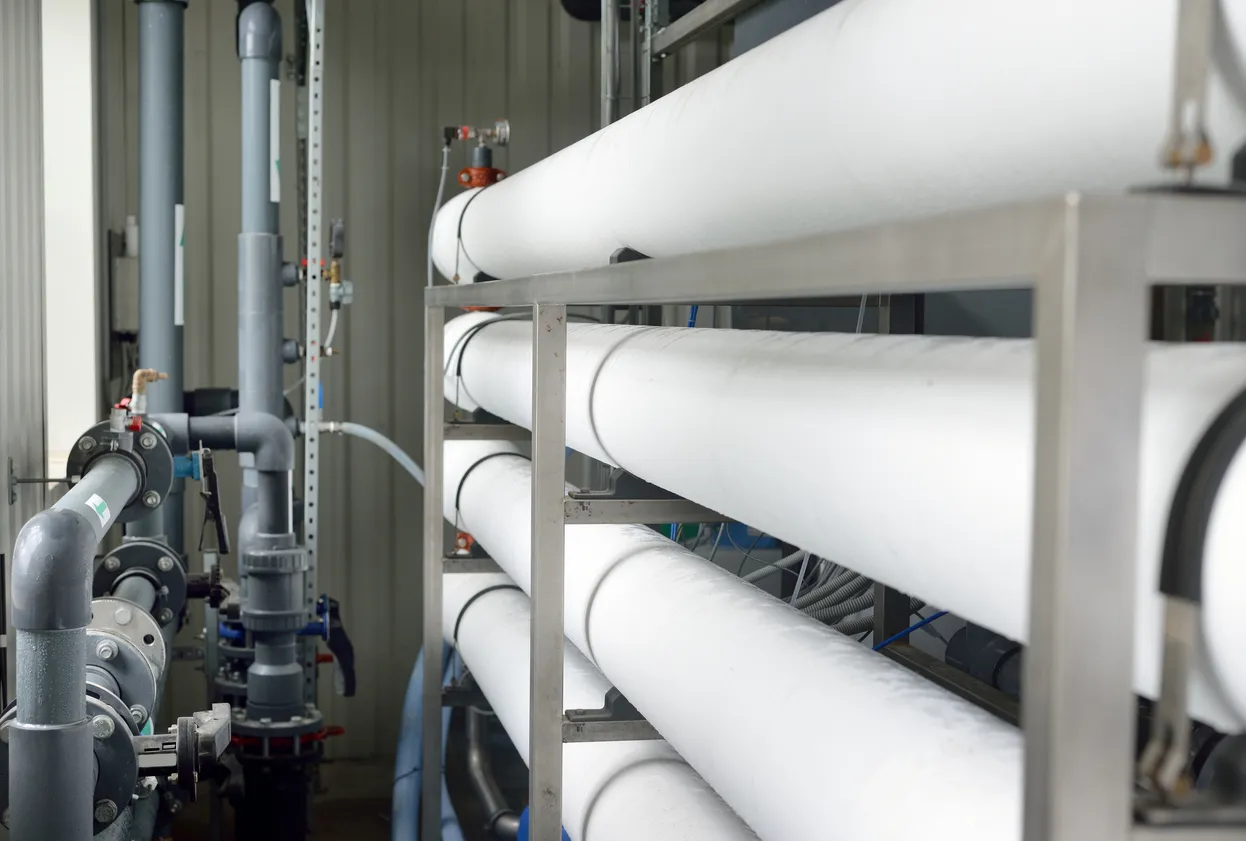
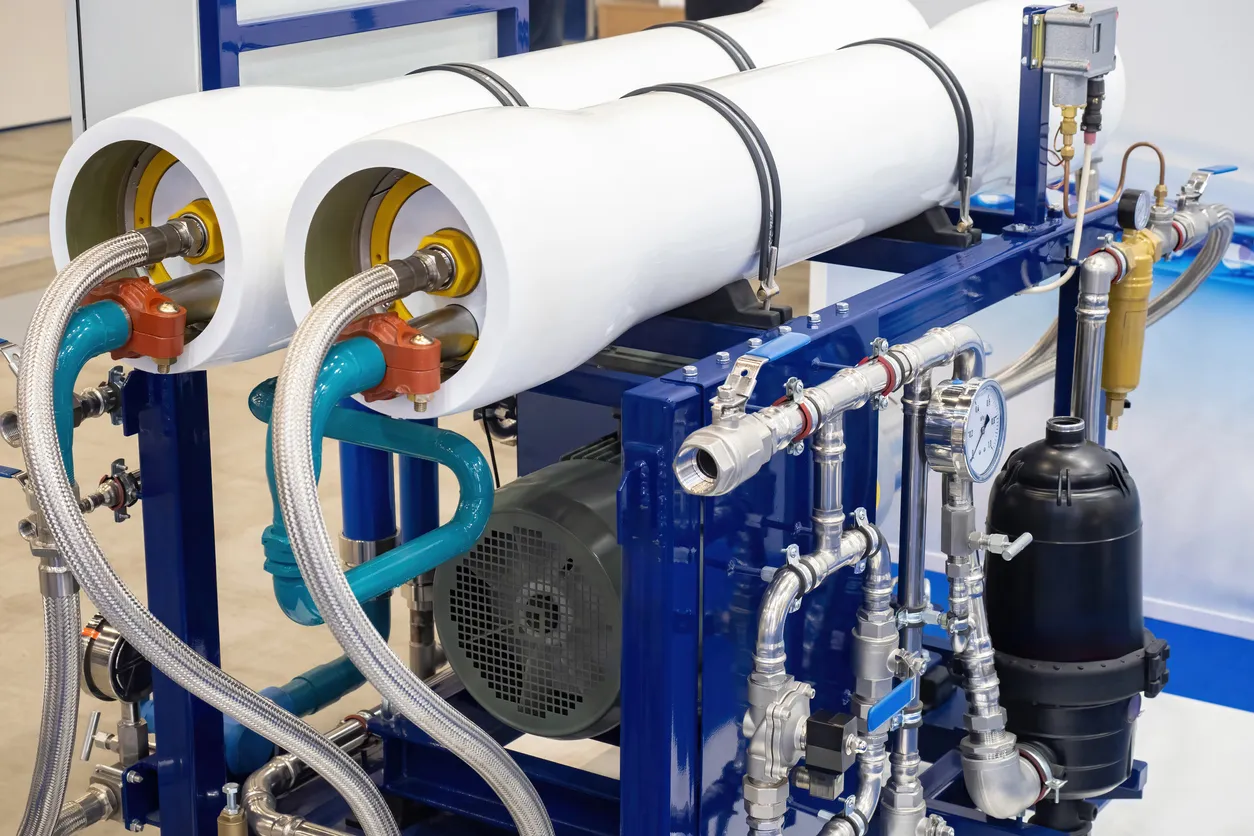
The system begins with pretreatment. Depending on the source water, pretreatment may include media filtration, cartridge filtration, antiscalant dosing, acid injection, dechlorination, softening, ultrafiltration or specific oxidation/filtration steps for iron and manganese. Pretreatment protects membranes from particulate fouling, biological growth, chlorine attack and mineral scaling. In agricultural environments, good pretreatment also reduces unexpected downtime during critical irrigation periods.
Permeate quality
Define conductivity, sodium, chloride and alkalinity targets according to crop and nutrient plan.
Recovery
Balance water savings against scaling risk, concentrate volume and membrane life.
Storage
Size permeate tanks for irrigation peaks, cleaning cycles and production continuity.
Membrane selection should consider salinity, temperature, pressure, recovery, expected fouling and required rejection. A design with aggressive recovery may look efficient on paper but become unstable if feedwater contains high hardness, silica or bicarbonates. A conservative design with appropriate pretreatment can reduce cleaning frequency and protect membrane life. This is why a greenhouse RO project should be reviewed as an integrated water system rather than an isolated equipment purchase.
Instrumentation is another important element. Conductivity meters, pressure transmitters, flow meters, tank level signals and differential pressure readings help operators identify changes before they affect crop irrigation. When a system includes automatic flushing, alarms and data logging, staff can respond to fouling, pump issues or pretreatment exhaustion faster. For larger sites, remote alerts and trend data can support maintenance planning.
Useful engineering references can be found in pages about sistema de osmosis inversa and ingenieria de osmosis inversa, especially when comparing modular systems, skid-mounted plants and integrated service packages.
Return to indexReverse osmosis for greenhouse water management
Use this index to review the engineering criteria behind reverse osmosis invernaderos, from feedwater evaluation to irrigation integration, maintenance and supplier selection.
Integrate RO permeate into fertigation without losing control
The RO plant should support irrigation decisions. It must be easy to monitor, clean, service and integrate with nutrient dosing, tanks and distribution loops.
Once permeate is produced, the greenhouse must decide how it will be used. Some operations feed RO permeate directly into the fertigation system; others blend permeate with raw water to reach a target conductivity, alkalinity or mineral balance. Blending can reduce operating cost and concentrate volume, but it requires stable controls and periodic verification. If the blend is manual, operators should have clear procedures and test records.
For hydroponics and high-value crops, water quality must be aligned with nutrient recipes. Low-mineral permeate gives agronomists more control, but it may require careful remineralization or pH adjustment. The RO system does not replace agronomy; it provides a cleaner and more predictable starting point. This is especially important when crop quality, uniformity, shelf life or export standards depend on consistent irrigation management.
Operational routines should include daily conductivity checks, feed and permeate pressure review, tank level monitoring, cartridge filter inspection and observation of recovery rate. Weekly or monthly routines may include normalized flow tracking, membrane differential pressure, chemical dosing confirmation and microbiological control in storage tanks. A good service provider should help create a log sheet that operators can actually use.
Cleaning should not be improvised. Clean-in-place procedures depend on the type of fouling: mineral scaling, organic matter, biofilm or particulate loading. Using the wrong chemical or delaying cleaning until production drops severely can shorten membrane life. The maintenance plan should define trigger points based on flow loss, pressure increase or rejection decline. For support, compare resources related to servicio de osmosis inversa and the service category servicios osmosis inversa.
Return to indexReverse osmosis for greenhouse water management
Use this index to review the engineering criteria behind reverse osmosis invernaderos, from feedwater evaluation to irrigation integration, maintenance and supplier selection.
What to evaluate before buying reverse osmosis for invernaderos
Purchasing teams should request more than a price and nominal flow. A complete proposal should include feedwater design basis, permeate target, pretreatment, recovery, membrane model, pump specifications, controls, instruments, electrical requirements, cleaning accessories, installation scope and service plan. It should also clarify whether the system is designed for continuous duty, seasonal operation or expansion.
Design basis
Confirm the analysis date, water source, temperature, flow demand, operating hours and crop-related quality targets.
Pretreatment
Review filters, chemical dosing, chlorine control, iron removal and cartridge protection before the membrane array.
Automation
Ask for alarms, automatic flush, tank interlocks, conductivity monitoring and operator-friendly status indicators.
Service
Evaluate startup, training, spare parts, membrane cleaning, emergency response and preventive maintenance.
For greenhouse projects, suppliers should also address concentrate handling. The reject stream may be used for non-sensitive areas, discharged according to local requirements or managed through a broader water balance. The best option depends on salinity, flow, site permits and irrigation strategy. Ignoring reject management can create hidden operating issues after installation.
It is also important to compare total cost of ownership. Energy use, antiscalant, filters, cleaning chemicals, membrane replacement, service labor and downtime all influence real cost. A lower-cost system without adequate pretreatment may become more expensive if membranes foul early or if irrigation interruptions damage production. Decision makers should request a transparent scope and operating assumptions.
When the project involves expansion, the system should be modular. Additional membrane vessels, pumps, tanks or control capacity may be required as greenhouse area grows. A scalable design prevents replacing the entire system too soon. The best technical decision is usually the one that balances crop requirements, water chemistry, operating discipline and long-term service support.
Return to indexAdditional technical considerations for a robust greenhouse RO project
A greenhouse reverse osmosis project should also define how operators will react when water quality moves outside the acceptable range. This includes alarm limits for permeate conductivity, tank low level, high pressure, low feed pressure and pretreatment failure. Practical alarms are more valuable than complex systems that no one reviews. The goal is to make deviations visible before they affect irrigation batches.
Membrane performance should be normalized when possible. Raw flow readings can be misleading because temperature, feed pressure and salinity influence production. Normalized permeate flow and salt rejection give a clearer picture of fouling or membrane aging. Even when the operator does not calculate normalized values every day, keeping consistent logs helps the service team diagnose changes faster.
Sanitary design may be relevant in facilities producing edible crops or seedlings. Permeate tanks and distribution lines should avoid stagnant zones, have accessible drains and support cleaning or disinfection when required. If the RO permeate is stored for long periods, biological control becomes important because low-salt water can still support microbial growth in tanks and piping.
Energy efficiency should be evaluated together with recovery and water quality. A high-pressure pump running outside its efficient range can increase cost. Variable frequency drives, correct pump selection and well-designed operating windows can reduce energy intensity. However, energy savings should not compromise membrane protection, flushing or stable operation.
Finally, the installation should include training. Operators should understand start-up, shutdown, flushing, cartridge replacement, chemical safety, alarm response and basic troubleshooting. Training reduces unnecessary service calls and helps protect crops during high-demand periods.
Return to index
Heat transfer fluids for data centers, HVAC and industrial applications
Omega Chemicals offers solutions such as DOWFROST™ LC, KOSTChill PG XL, OMEGA DO LC30 and OMEGA DO LC25 for reliable thermal performance in critical applications.
- DOWFROST™ LC for data centers.
- KOSTChill PG XL for HVAC and computing.
- PG fluids for heat transfer.
- OMEGA DO LC30 PG 30 heat transfer fluid.
- OMEGA DO LC25 for industrial engines.
- Guidance in selecting the right product.
Reverse osmosis for greenhouse water management
Use this index to review the engineering criteria behind reverse osmosis invernaderos, from feedwater evaluation to irrigation integration, maintenance and supplier selection.
Frequently asked questions about reverse osmosis for invernaderos
When does a greenhouse need reverse osmosis?
A greenhouse should evaluate reverse osmosis when feedwater salinity, sodium, chloride, bicarbonates or hardness interfere with crop quality, nutrient control or emitter reliability. The need depends on crop sensitivity, irrigation strategy, substrate and the variability of the source water.
Does RO water need to be remineralized?
In many cases, yes. RO permeate is low in dissolved minerals, which gives the grower a clean starting point. The fertigation program can then add nutrients and adjust pH according to the crop. Some sites also blend permeate with raw water to reach a target mineral balance.
How should RO capacity be sized for greenhouses?
Capacity should be based on peak irrigation demand, operating hours, storage volume, recovery and water quality target. A system may run continuously to fill a tank or be sized for direct demand. The correct approach depends on irrigation windows and production risk.
What pretreatment is required?
Pretreatment depends on the feedwater analysis. Common elements include media filtration, cartridge filtration, antiscalant, acid dosing, softening, dechlorination or iron removal. The purpose is to protect membranes from fouling, scaling and chemical damage.
Can RO reduce crop stress?
RO can help reduce salt-related stress by lowering dissolved salts and specific ions that accumulate in the root zone. It does not replace agronomic management, but it improves the consistency of the water entering the fertigation system.
What should be checked before buying?
Review the feedwater analysis, permeate quality goal, pretreatment design, membrane recovery, concentrate handling, storage, automation, service response and consumable costs. A strong proposal should connect engineering details with greenhouse operating needs.
For decision makers comparing reverse osmosis invernaderos, the most important point is to treat the RO plant as part of the irrigation and nutrient-control strategy. The system must match crop requirements, available water, service capability and long-term operating discipline. A well-designed project improves predictability, while an underspecified system can create new maintenance issues.
Useful internal references include sistema de osmosis inversa, ingenieria de osmosis inversa, servicio de osmosis inversa and servicios osmosis inversa.
Return to index
Temas que te pueden interesar
Estos productos podrian interesarte